Frame damage repair cost
Updated 2026-10-19 · By the Car Repair Estimator team
Frame damage repair typically costs about $600-$10,000, depending on how much of the structure is bent and whether parts can be straightened or have to be cut out and replaced. A whole front-end collision repair that includes frame work can run about $8,000-$20,000, and repairs that large can approach the point where an insurer declares the car a total loss.
Frame damage repair costs by severity
"Frame damage" covers everything from one slightly bent rail to a twisted body shell, so the price range is wide. Caliber Collision puts frame straightening at about $600-$10,000, and Brea Auto Body describes a range from a few hundred dollars for a minor pull to well over $10,000 for extensive rail replacement and calibration. The table breaks that down by severity and by type of crash.
| Damage or repair | Typical cost range | Notes |
|---|---|---|
| Frame straightening, overall range | $600-$10,000 | Caliber Collision; extent of damage is the biggest factor |
| Minor: simple front-end realignment and welding | $600-$1,500 | SCA Auction frame damage guide |
| Moderate: replacement parts and precision alignment | $2,000-$4,000 | Same guide |
| Severe: multi-point pulls or replaced subframe sections | $6,000 or more | Same guide; more on cars with complex materials |
| Front-end collision with frame work, whole repair | $8,000-$20,000 | California shop guide; includes body and paint work |
| Rear-end collision with quarter panel sectioning | $6,000-$15,000 | Same California guide |
| Side impact with structural pillar repair | $8,000-$18,000 | Same California guide |
| ADAS calibration | Add $200-$600 per system | $800-$1,500 when several systems need it (same California guide) |
Ranges are compiled from shop and industry guides published in 2025-2026, and they overlap because each guide groups damage differently. Use the table to sanity-check a quote, not as a price for your car.
What frame damage is: body-on-frame vs unibody
Pickup trucks, some vans and many large SUVs are still built body-on-frame: the body bolts onto a separate steel ladder frame. Most modern cars and crossovers are unibody, meaning the body shell and the frame are welded into one structure. On a unibody car, "frame damage" usually means damage to structural parts such as the frame rails or pillars, not to a separate frame.
The difference matters for cost. MOTOR notes that unibody structures have crumple zones that make them harder to repair, and that many unibody repairs need special hydraulic tools and trained technicians. Brea Auto Body points out that the construction type changes the tools used, not the accuracy the repair must meet.
Signs of frame damage
- The car pulls or drifts to one side on a flat, straight road, or tracks diagonally.
- Doors, hood or trunk no longer line up or close flush, or panel gaps are uneven.
- Tires wear unevenly within a few thousand miles of the accident.
- Steering still pulls after an alignment, or new rattles and squeaks appear.
- Cracks, crooked welds or shifted mounts in the wheel wells or engine bay.
None of these proves frame damage on its own. A shop has to measure the structure to know.
How frame damage is measured and repaired
Measuring
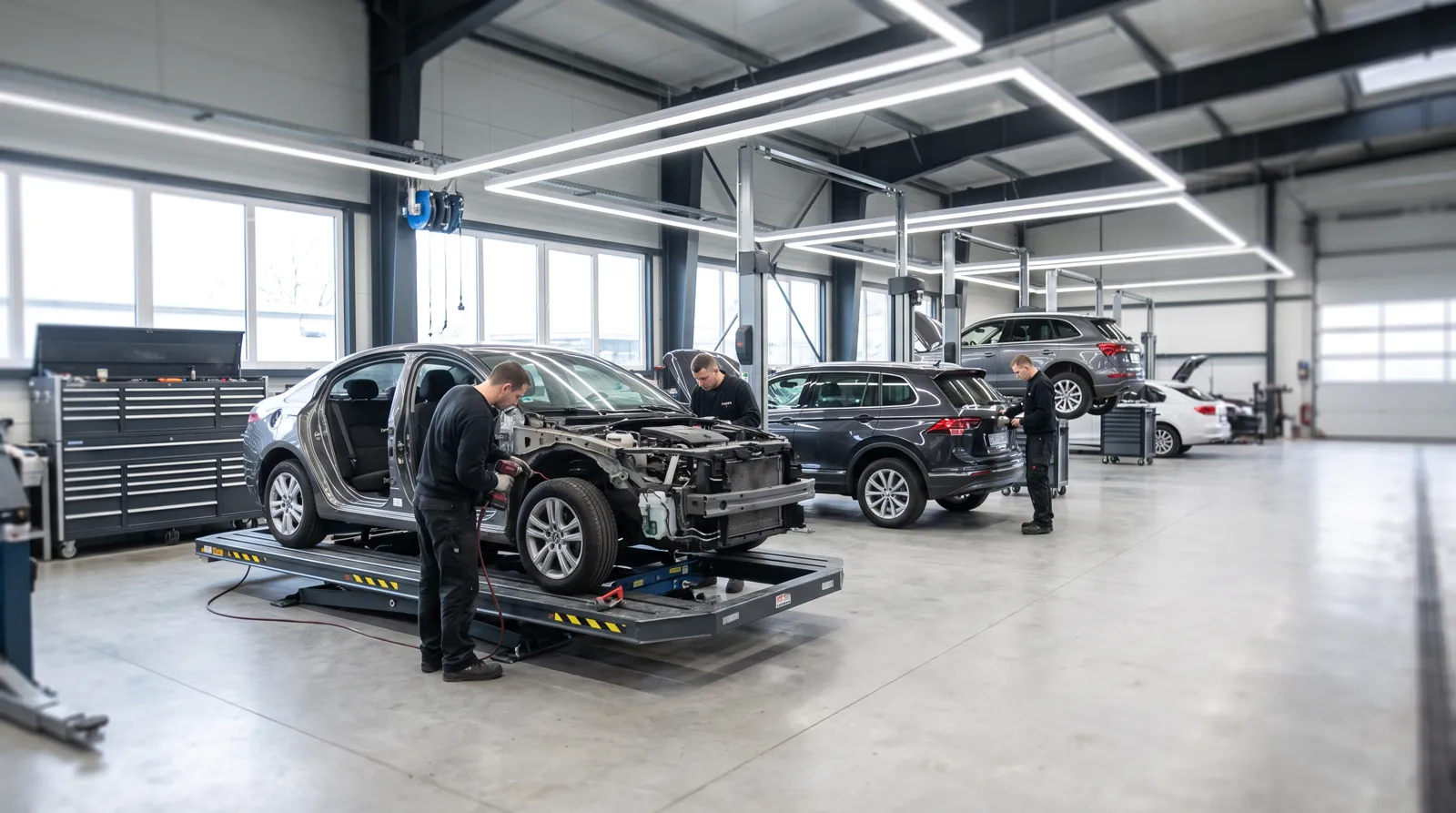
The shop compares reference points on the body against the automaker's published dimensions. Modern measuring systems use lasers or stereo cameras to map those points with millimeter accuracy. I-CAR trains technicians separately on full-frame and unibody measuring, anchoring and pulling, and tells them to always refer to the automaker's repair information. Ask for the measurement printouts; they document both the damage and the finished repair.
Straightening on a frame machine
The vehicle is clamped to a frame machine, and hydraulic towers pull the structure back into position while technicians watch the measurements. Honda's repair guidance, as reported by Repairer Driven News, tells technicians to apply pulling force gradually and to monitor body dimensions throughout. Straightening has limits. I-CAR says kinked parts, meaning sharp bends that will not return to their original shape, must be replaced, and that crush zones, bumper reinforcements and door intrusion beams should not be straightened at all. It also advises against straightening steel above 600 MPa unless the automaker documents that it is allowed. Honda says its high-strength steel parts over 590 MPa must not be straightened, and any ultra-high-strength steel part that has been straightened with heat or cold must be replaced.
Sectioning and replacement
When a part can't be straightened, the shop either replaces the whole part or sections it, cutting out the damaged portion at locations the automaker specifies and welding in a new piece. MOTOR notes that sectioning is not an option when the manufacturer prohibits it or when the damage is near drivetrain or engine mounts, and that these procedures must be done exactly as the manufacturer recommends. Replacement and sectioning add parts and welding, which is why they cost more than a pull alone. For how these operations show up as labor hours on an estimate, see our labor time guide.
What drives the cost
Extent and location of damage
Caliber names the extent of the damage as the biggest cost factor, followed by the make and model, since parts for newer and more expensive cars cost more. Damage that reaches pillars, rockers or the floor costs far more than a bent front rail.
Labor rates
Structural work is labor-heavy, so the local rate matters. One California shop says quality shops there charge about $90-$125 per hour in 2026, up from about $60 in 2015. Rates in your area may be higher or lower.
Driver-assistance systems
Cameras and radar are mounted to the structure, so pulling or replacing structural parts can change where they point. Ford and Lincoln's updated position statement requires calibration after repairs to parts that hold or affect the position of driver-assistance sensors, such as bumper beams, quarter panels and mounting brackets, along with pre- and post-repair scans. Calibrations are often added after the first estimate: CCC data showed that 56.5% of calibrations on early-2025 insurer direct-repair jobs appeared on a supplement.
Hidden damage
Structural damage is often only fully visible once panels come off, so frame repairs commonly grow through supplements. Ask how changes will be approved before work starts. For the full picture of a crash repair, see collision repair cost.
Insurance, total loss and resale value
Insurers compare the repair cost with the car's actual cash value, which factors in depreciation, mileage and prior accidents. Each state sets its own rules, and not every state has a fixed percentage threshold. As an example, AAA Club Alliance notes that some thresholds are 75%: a $10,000 car needing $7,500 or more in repairs may be totaled. A car with structural damage is not automatically a total loss, and you can generally choose your own repair shop. Rules vary by state and policy, so check with your insurer or state insurance department.
Frame damage can also follow the car. CARFAX Canada says it shows frame damage when a data source reports it, and notes that a frame-mounted snowplow or trailer hitch, prior police use or heavy rust can trigger the same report. CARFAX found that accident damage lowers a used car's retail price by about $500 on average and about $1,700 when the damage was severe. If someone else caused the crash, read about diminished value claims.
Getting it repaired safely
Choose a shop with a frame machine, a measuring system and technicians trained on your make, and ask whether it will follow the automaker's repair procedures and give you before-and-after measurements. An improperly repaired structure may not protect occupants as designed in a later crash.
To start an estimate, photograph the whole car, close-ups of the damage and any uneven panel gaps. With Car Repair Estimator a shop or owner can photograph the damage and get an itemized estimate draft. Final structural pricing still requires measuring the car at a qualified shop.
Frequently asked questions
How much does it cost to fix frame damage?
Caliber Collision puts frame straightening at about $600-$10,000. One guide puts simple front-end realignment and welding at about $600-$1,500, moderate repairs with replacement parts at about $2,000-$4,000, and severe cases with multi-point pulls or replaced subframe sections at $6,000 or more. Driver-assistance calibration is often extra.
Is a car with frame damage worth fixing?
It can be. Frame damage is often repairable when a shop has the right equipment and follows the automaker's repair procedures. Insurers compare the repair cost with the car's actual cash value, and each state sets its own rules for when a car is a total loss. One AAA example uses a 75% threshold: a $10,000 car with $7,500 or more in repairs may be totaled.
Can a bent frame be straightened?
Sometimes. I-CAR says bent parts may be repairable, but kinked parts, meaning sharp bends that will not return to their original shape, must be replaced. Crush zones, bumper reinforcements and door intrusion beams should not be straightened, and many high-strength steels cannot be straightened unless the automaker allows it.
Does frame damage show up on a vehicle history report?
It can, if a data source reports it. CARFAX Canada notes that a frame damage report does not always mean a crash. A snowplow or trailer hitch mounted to the frame, prior police use or heavy rust can also trigger it. CARFAX found that accident damage lowers retail price by about $500 on average and about $1,700 for severe damage.
Sources
- Caliber Collision - Car frame straightening: a complete guide
- SCA Auction - Car frame damage guide (Jul 2025)
- Executive Auto Body & Paint - Auto body repair cost in 2026 (Nov 2025)
- Brea Auto Body - Frame damage repair 2026: costs, process and safety (Feb 2026)
- I-CAR - Kink vs. bend
- I-CAR - Full-frame and unibody measuring, anchoring and pulling courses
- MOTOR - Are your frame rail repair skills up to snuff? (May 2023)
- Repairer Driven News - Honda newsletter on ultra-high-strength steel repair information (Jul 2026)
- Repairer Driven News - Ford, Lincoln mandate standards in updated ADAS position statement (May 2026)
- Repairer Driven News - New CCC report: scans and calibrations now routine at DRP shops (Sep 2025)
- Repairer Driven News - Structural and frame damage: how to know what's repairable (Mar 2023)
- AAA Club Alliance - When is a car considered totaled? (Jul 2023)
- CARFAX - Don't let accident reports steer you away from a used car
- CARFAX Canada - Why was structural/frame damage reported?
Get an estimate for your car
Snap the damage and get an itemized estimate with parts and labor in minutes.
More in repair costs