How to price paint jobs
Updated 2026-10-19 · By the Car Repair Estimator team
To price a paint job, build it from parts: refinish labor hours times your refinish rate, paint and materials, then every operation the book time leaves out, such as blending, color tinting, spray-out cards, three-stage work, de-nib and polish, and removing parts. Most under-priced paint jobs aren't wrong on the rate. They're missing lines. Here is how to account for each one, and how to quote full repaints in tiers.
The parts of a paint job price
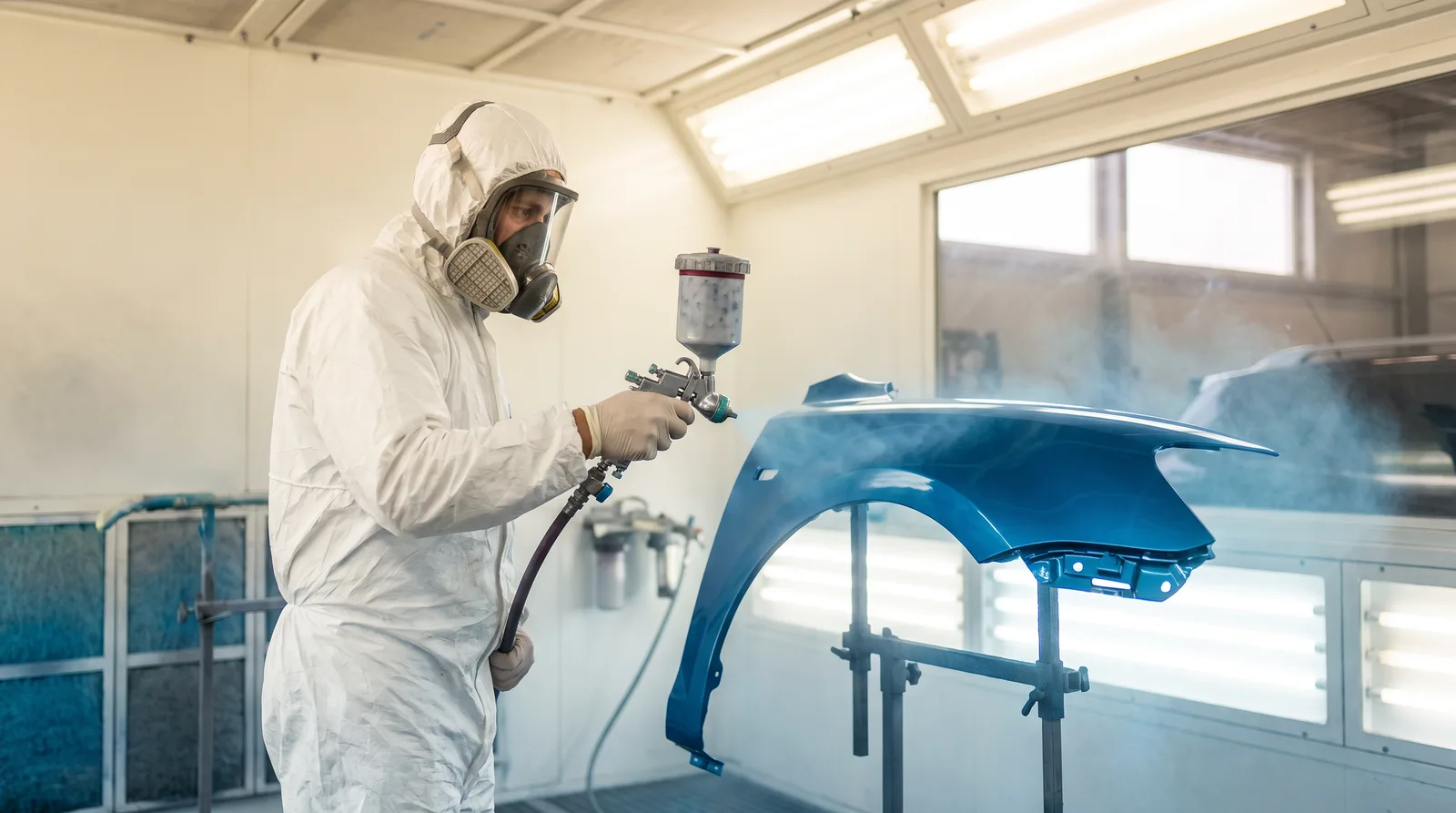
A collision refinish estimate is a stack of separate operations, each with its own hours or dollars. Estimating systems (CCC, Mitchell and Audatex/Qapter) supply base refinish times, but their procedure pages, often called P-pages, spell out what those times leave out. As one 2019 industry training session summed it up, usual panel refinish times contain only wash, scuff, primer/seal, basecoat and clearcoat.
| Line item | How it's usually figured | What to check |
|---|---|---|
| Panel refinish | Database refinish hours × refinish labor rate | Edges, jambs, inner panels and underside are often separate |
| Paint and materials | Refinish hours × P&M rate, or a materials calculator or invoice | Rate keeps up with supplier price increases |
| Blend adjacent panels | Estimator judgment; no fixed formula in CCC/MOTOR or Audatex | Note why the blend is needed |
| Clear coat | Add-on calculated by the estimating system | Clear to the panel edge or breakpoint for paint warranties |
| Three-stage / tri-coat | Percentage add-on to refinish time | Blended tri-coat panels too |
| Color tint and spray-out | Manual labor entry | Not in base refinish time |
| Masking beyond the included area | Manual entry | Blackout areas, jambs, openings |
| De-nib, finish sand and polish | Percentage of refinish time or on-the-spot evaluation | Spot polish vs full-panel polish |
| R&I for paint access | Book time per part | Mirrors, grilles, lamps, moldings, handles |
| Adhesion promoter, flex additive | Labor and material lines | Raw plastic parts, bumper covers |
Refinish labor
Start with the database refinish time for each panel and multiply by your refinish labor rate. Rates vary widely by region and by shop, so use your posted rate, not a national figure. The base time assumes a new, undamaged part. In that 2019 training, CCC's language was quoted saying refinish times do not include disassembly of components such as mirrors, grilles and headlamps, so list removal and installation (R&I) separately. Trainers also said masking up to 36 inches and a car cover are included, but anything beyond that is additional. In MOTOR's updated refinish guidelines, reviewed by the CIC Estimating Committee in 2024, flash and wait time between coats is listed as not included, as is setting up a unique stand to hold parts. See the labor time guide for how book time works overall.
Paint and materials
Most shops price materials with a multiplier: refinish hours times a paint and materials (P&M) rate. In the Q1 2025 Who Pays for What? survey, multiplier shops averaged $50 per refinish hour nationally, and 84% charged between $40 and $60. Only 37% used the multiplier alone, and 26% said they always use a materials calculator. Costs move quickly. Weighted average P&M prices from the five major refinish brands rose 7.4% in early 2025, and announced increases totaled 59.6% since Q1 2020. If your rate hasn't changed in a few years, check it against your actual paint invoices.
Blending adjacent panels
Blending lets the new color fade into the neighboring panel so the repair isn't visible. For years the estimating systems gave blend about 50% of the panel's refinish time. That formula is gone. CCC/MOTOR now defers blend time to the estimator's judgment, Solera removed its 50% formula from Audatex, and Audatex lets users set a blend percentage between 50% and 150%. CCC allows defaults up to 200%. Mitchell said it had no change to its blend guidance at that time.
The change followed a 2022 SCRS study finding that blending took 31.59% more time on average than a full refinish. Expect pushback on insurance work. In the 2026 Who Pays for What? survey, only 20% of shops negotiating more blend time said insurers "always" or "usually" paid it, down from 40% in 2024. Write down why each blend is needed and keep the photos and spray-out card.
Clear coat
On basecoat/clearcoat finishes, clear coat is a separate add-on, and each estimating system calculates it its own way. Check your system's P-pages and don't assume it's built into the panel time. Paint makers generally require clear to be extended to the nearest panel edge or breakpoint to qualify for their refinish warranties. The DEG noted in 2019 that none of the estimating services automatically included that extension. Axalta's 2025 guidance adds that most vehicle manufacturers do not recognize clearcoat blending inside a panel, and that the blend edge can become visible during the vehicle's service life.
Color match: tint and spray-out
CCC states that refinish times do not include time to match color tints. Mitchell and CCC also exclude mix-and-match spray-out, and color lookup and adhesion promoter are separate. PPG's spray-out procedure has you spray the card with the same equipment and technique as the vehicle, over the specified gray undercoat, then clear it. Check it in natural light at the face, flash and flop angles. PPG recommends 2-4 hours of dry time for solid colors before you judge the card, and 8 hours or more, if possible, for tri-coats. That's real time, and it belongs on the estimate.
Three-stage and tri-coat
Tri-coat pearls get an additional percentage on top of refinish time. In the DEG's 2018 summary, CCC added 70% for the first major panel and 40% for each additional panel, and blended tri-coat areas were counted at 70% of base refinish time. Mitchell's guidance was similar. Confirm the current numbers in your system before relying on them, and budget for a let-down panel.
De-nib, finish sand and polish
De-nibbing removes isolated dirt in fresh paint. Full finish sanding and buffing removes orange peel to match factory texture. These are different operations, often with different allowances. Fender Bender's 2020 summary of MOTOR guidance listed de-nib at up to 20% of base refinish time for the first hood, roof, trunk lid or spoiler, and finish sand and buff at 30% per panel. Qapter treats nib sanding as an on-the-spot evaluation.
Quoting whole-car repaints
A full repaint is usually priced by scope, not panel by panel. Estimate prep hours (dent, rust and scratch repair), disassembly, masking, booth time, materials for the whole vehicle and finishing. Then present it in tiers. AAA's consumer ranges give a useful frame: basic jobs at $300-$1,000 with minimal prep, mid-grade at $1,000-$4,500 with better prep and multiple coats, and high-end at $5,000-$20,000 with work like sanding to bare metal. AAA also notes that color changes cost more, because the original color can show through.
- Good: same color, exterior surfaces, scuff and seal, minimal disassembly.
- Better: more disassembly, panel-by-panel dent and scratch repair, full clear coat, de-nib and polish.
- Best: parts off, jambs and openings, color change if wanted, finish sand and buff.
Spell out what each tier excludes. A customer comparing your "better" with another shop's cheap price needs to see the prep difference. For consumer-side pricing, see cost to repaint a car and car scratch repair cost.
Document with photos
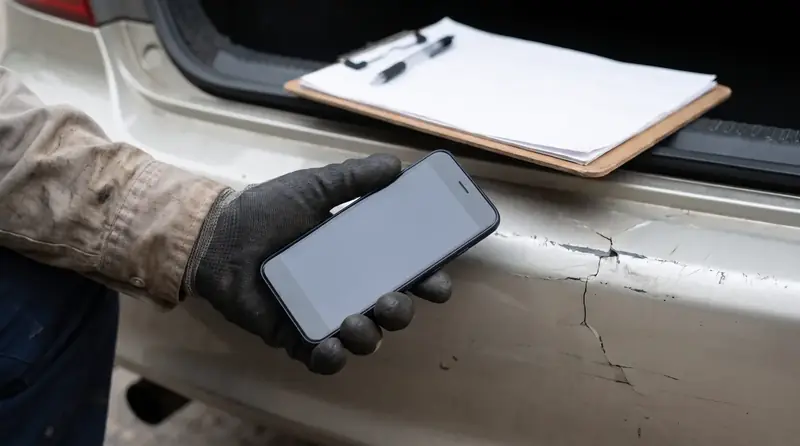
Photograph each damaged panel, the adjacent panels you plan to blend, the paint code label, existing fade or failed clear, and the finished spray-out card held against the car. Photos back up blend, tint and polish lines when they're questioned. To speed up the first draft, Car Repair Estimator Repair+ turns photos of the damage into an itemized estimate draft that you can adjust before sending.
Common under-pricing mistakes
- Pricing panel refinish only, with no blend, clear, tint or spray-out lines.
- Leaving out R&I of mirrors, handles, moldings and lamps.
- Using an old P&M rate after supplier price increases.
- Missing the three-stage add on pearl colors, including on blended panels.
- Skipping adhesion promoter on raw plastic and masking for blackout areas.
- Quoting a repaint without a defined prep scope, then absorbing the extra bodywork.
For the full estimate layout, see how to write an auto repair estimate. Estimating system rules change, so check the current P-pages and your paint manufacturer's procedures.
Frequently asked questions
How do body shops charge for paint and materials?
Most shops multiply the estimate's refinish hours by a paint and materials rate. In the Q1 2025 Who Pays for What? survey, shops using that multiplier method averaged $50 per refinish hour nationally, and 84% of them charged $40-$60. Others use a materials calculator or a mix of both. Your rate should reflect your own costs and market.
How much time should I charge to blend a panel?
There is no longer a fixed formula in CCC/MOTOR or Audatex. Both moved blend time to estimator judgment, replacing the old 50% of refinish time rule. A 2022 SCRS study found blending took 31.59% more time on average than a full refinish. Document why each blend is needed.
Is color tinting included in refinish time?
No. CCC states that refinish times do not include time that may be required to match color tints. Spray-out cards, color lookup and adhesion promoter are generally separate operations as well, so add them as their own lines when you do them.
How much does a full car repaint cost?
AAA puts basic paint jobs at about $300-$1,000, mid-grade jobs with better prep and multiple coats at about $1,000-$4,500, and high-end work at about $5,000-$20,000. Your own price depends on prep, color, size and your labor rate.
Sources
- Repairer Driven News - 'Repair U': Stock refinish times include few operations (2019)
- Repairer Driven News - CIC Estimating Committee overviews changes to CCC, Mitchell and Qapter (2024)
- Repairer Driven News - Audatex updates DBRM refinish guidelines, removes 50% blend formula (2023)
- Autobody News - Who Pays for What? survey: insurers push back on blend time (2026)
- Repairer Driven News - Paint and material costs up by average 7.4% during Q1 (2025)
- Repairer Driven News - DEG tips on clear coat (2019)
- Repairer Driven News - Axalta releases recommendation on blending clearcoat (2025)
- PPG Refinish - PD-0632: Creating sprayout card
- Repairer Driven News - DEG tips on three-stage paint (2018)
- Fender Bender - Account fully for paint work (2020)
- AAA - How much does it cost to paint a car
Estimates and invoices in minutes
Car Repair Estimator turns a photo into an itemized estimate, then an invoice. Free to download.
More in for shops