 Car Repair Estimator
Pricing and estimating for a paintless dent repair business
Updated 2026-09-29 · By the Car Repair Estimator team
Pricing is the hardest part of running a paintless dent repair business. Charge too little and you work for free on the tough dents; quote inconsistently and customers shop you. This guide covers how PDR techs price single dents and hail, what a PDR estimate should show, and when to send the job to a body shop instead.
What customers are paying for PDR
Before setting your own prices, know the local market. Our paintless dent repair cost guide compiles typical US prices from PDR shops: about $75-$150 for a small door ding, $150-$400 for a medium dent, and $400-$1,200 for a sharp crease on a door, with aluminum panels commonly costing about 10-20 percent more. Hail runs higher and is priced differently; see hail damage repair cost. Your own prices should come from those market ranges, your skill and your costs, including travel if you're mobile.
How to price a single dent
Most PDR techs start from a base price by size and adjust. Working through the same factors in the same order on every job is what makes your quotes consistent.
1. Size
Measure the dent's diameter. Small dings about an inch or less are the base of most price sheets, with steps up for larger dents.
2. Depth and stretch
Two dents of the same width can be very different jobs. A deep dent has stretched metal that takes much longer to work out without leaving high spots. Price depth separately from size.
3. Crease vs round
A crease, such as a shopping cart line down a door, takes longer than a round ding and may not come out perfectly. Price creases by length and sharpness, and set expectations if a full repair isn't realistic.
4. Location and access
Middle of a door or fender is simplest. On a body line, near an edge, on a roof rail or behind a brace takes longer. Add a line for removing and installing trim, interior panels, lamps or liners when you need access, or note when you'll glue-pull from the outside.
5. Panel material
Aluminum is harder to work and less forgiving. Retail PDR shops commonly add around 10-20 percent. The hail matrix method described below applies a 25 percent markup for aluminum or high-strength steel panels.
6. Count
Charge the most for the first dent and less for additional dents on the same visit. Customers with three dings on one car are easier to convert when the second and third come at a discount.
How hail is priced: the PDR matrix
Hail work is priced panel by panel using a matrix. As IA Path, a training resource for insurance adjusters, describes it, the adjuster or tech identifies the panel, counts the dents, decides what size the majority of dents are (dime, nickel, quarter or half dollar), and reads the price from the matrix for that count and size. Common adjustments in that method:
- Aluminum or high-strength steel panels: multiply the panel price by 1.25.
- Oversize dents: anything larger than a half dollar is priced as an oversize dent at an added amount per dent.
- Double-metal roof rails and extended truck or SUV roofs: a separate 25 percent markup in that method.
- Remove and install for headliners, lamps, moldings and trim, listed separately.
Insurers and hail companies use their own matrices, and the numbers differ. If you're working insurance hail claims, you'll be working to the insurer's matrix and estimating system. For retail hail customers paying out of pocket, a matrix-style breakdown by panel still helps them see where the money goes.
How to write a PDR estimate
A dent repair estimate should be as specific as a body shop estimate, just with different lines. Include:
- Customer and vehicle: year, make, model, color, VIN and mileage.
- A line per dent or per panel: panel name, dent count, size, and notes like "on body line" or "crease, 4 inches."
- Adjustments on their own lines: aluminum, oversize dents, access work, glue pulling.
- Conventional repair items if any dent has paint damage: body labor, refinish, blend and paint materials, or a note that this part will be referred out.
- Total, validity and terms, including what happens if a dent can only be improved, not fully removed, and whether paint could crack during repair on previously repaired panels.
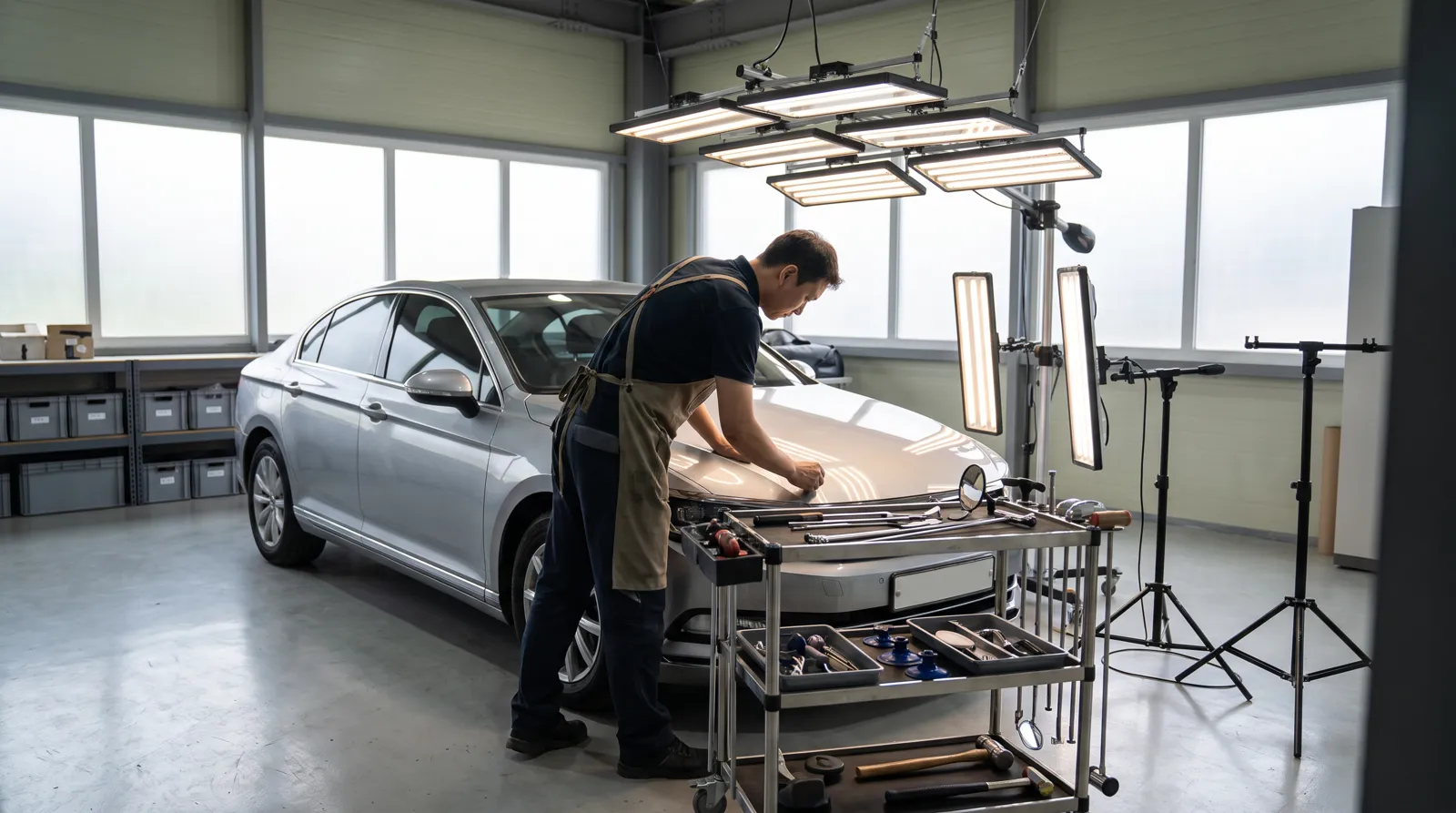
- Photos, taken under your light board, attached or referenced.
A clear, itemized estimate does two jobs: it justifies the price, and it records the car's condition before you touch it.
When PDR isn't the answer
PDR needs intact paint. Refer or quote conventional repair when:
- The paint is cracked, chipped or flaking.
- The metal is too stretched to hold its shape.
- The panel has body filler from a previous repair.
- The dent is on an edge or seam you can't reach.
Those jobs need filler, primer, paint and often blending. Knowing typical fender repair and repaint prices helps you explain the difference to the customer. Many PDR techs have a body shop partner for these.
Quoting faster from the field
A lot of PDR leads arrive as a text with a photo. If you want to answer with an itemized estimate instead of a single number, Car Repair Estimator Repair+ builds one from a photo, a note or dictation and a VIN scan, at the hourly rates you set, and sends it as a branded link or PDF. When the dent turns into a paint job, the same estimate can show repair vs replace, body labor, refinish hours, blend and paint materials on separate lines. Approved estimates convert to invoices in one tap. Estimates are informational, not insurance appraisals.
Keep your price sheet honest
Review your prices every few months against the jobs you actually did. If creases on body lines keep taking twice as long as you quoted, raise that line. If you're winning every quote, you may be too cheap. Consistent, itemized quotes are what let you make those adjustments with confidence. For more on setting your hourly rate, use the labor rate calculator.
Frequently asked questions
How do you price paintless dent repair?
Start from the dent's size and depth, then adjust for location and access, crease vs round, panel material and how many dents are on the same visit. Hail work is usually priced per panel with a matrix of dent count and dent size.
What is a PDR matrix?
A chart that sets a price for each panel based on how many dents it has and their typical size, such as dime, nickel, quarter or half dollar. Markups are added for aluminum or high-strength steel and for oversize dents.
What should a dent repair estimate include?
The vehicle and VIN, each dent or panel with size, count and location, the price per line, any add-ons like aluminum, oversize dents or removing and installing trim, conventional repair items if paint is damaged, total, and terms.
When should a PDR tech refer a dent to a body shop?
When the paint is cracked or chipped, the metal is too stretched to hold its shape, the panel has old body filler, or the dent is on an edge or seam PDR tools can't reach.
Sources
- IA Path - How to estimate auto hail damage with a PDR matrix
- Patriot PDR - How much does paintless dent repair cost (2025)
- Carlson PDR - How much do car dents cost to repair (2026)
Estimates and invoices in minutes
Car Repair Estimator turns a photo into an itemized estimate, then an invoice. Free to download.
More in for shops